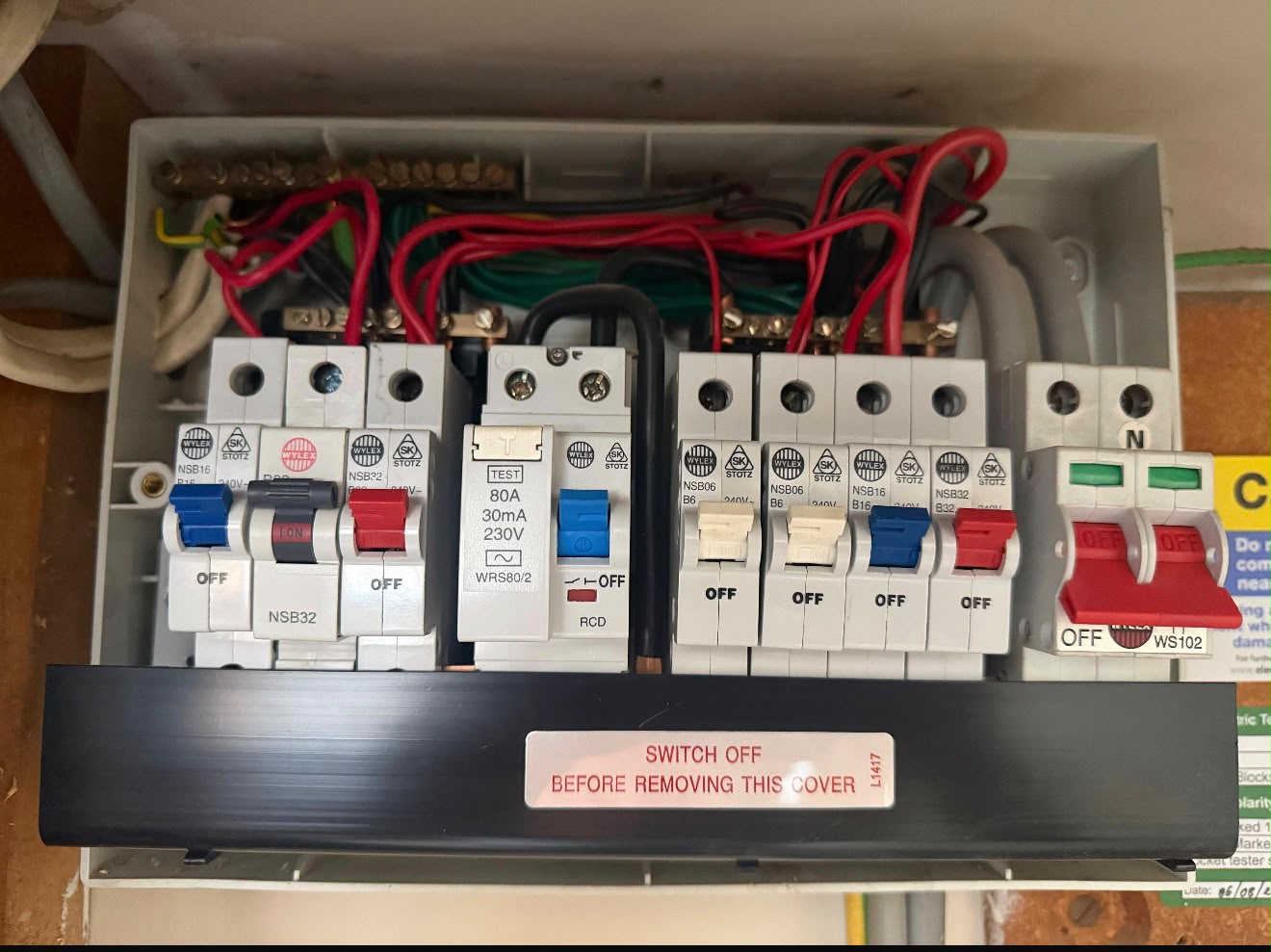
If the consumer unit in your home looks similar to the one pictured, you may be wondering whether it’s still safe, whether it needs upgrading, or what protection a newer consumer unit would provide.
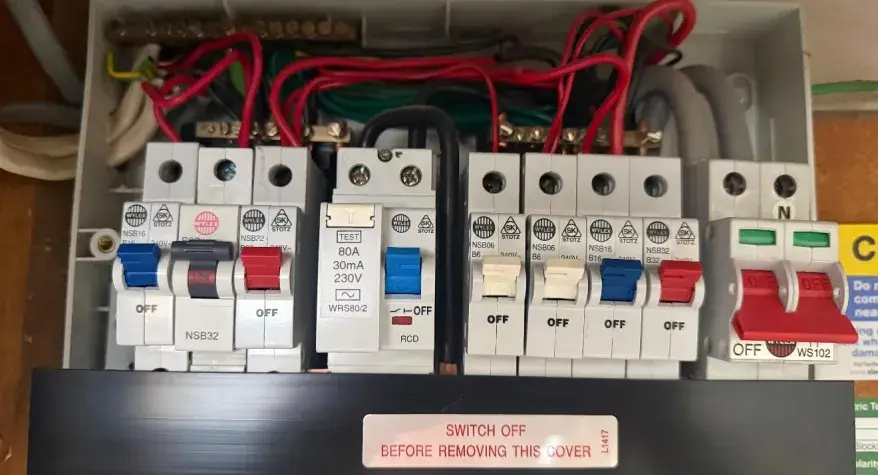
This particular consumer unit is a good example of something we regularly come across while carrying out Electrical Installation Condition Reports (EICRs) in properties throughout Banbury, Brackley, King’s Sutton and the surrounding areas.
It’s important to say from the outset that having an older consumer unit like this doesn’t automatically mean that it’s unsafe or that it must be replaced. However, electrical safety standards have developed considerably since consumer units of this type were commonly installed, and there are several improvements that a modern consumer unit can provide.
Only Three Circuits Have 30mA RCD Protection
One of the first things we can see from the photograph is that this is a split-load consumer unit.
There is a single 80A 30mA RCD, with only three of the circuits appearing to be connected to the RCD-protected section of the board. The remaining circuits are protected by MCBs but don’t appear to have additional 30mA RCD protection.
30mA RCD protection is an important safety measure. An RCD monitors the electrical current flowing through a circuit and can rapidly disconnect the supply when it detects certain levels of leakage to earth.
Modern electrical installations generally require much wider use of 30mA additional protection than was common when consumer units such as this were installed.
When upgrading consumer units, we generally use individual 30mA RCBO protection for each applicable circuit. One benefit of RCBOs is that a fault on one circuit doesn’t necessarily result in several unrelated circuits losing power at the same time.
It’s Also a Type AC RCD
If you look closely at the RCD in the photograph, you can see the symbol identifying it as a Type AC RCD.
Type AC RCDs were commonly used for many years, but the equipment connected to our homes has changed enormously.
Modern homes contain LED lighting, computers, televisions, washing machines, electronic power supplies, chargers and numerous other electronic devices. These can produce residual currents that aren’t simply traditional sinusoidal AC.
A Type A RCD or RCBO can detect sinusoidal AC residual currents as well as pulsating DC residual currents.
This makes Type A protection more suitable for many of the electrical loads found in today’s homes and is why we generally install Type A RCBOs when replacing domestic consumer units.
Why Is the Consumer Unit Plastic?
Another obvious feature of the consumer unit pictured is its plastic enclosure.
Plastic consumer units were extremely common and there are still huge numbers of them installed in UK homes.
Current requirements for domestic installations generally require new consumer units and similar switchgear assemblies to have enclosures manufactured from non-combustible material, such as steel, or to be enclosed within a suitable non-combustible cabinet.
For that reason, the consumer units we install today are normally metal-clad units.
This requirement is intended to improve fire containment should overheating or a fault occur within the consumer unit.
However, it’s worth repeating that the presence of a plastic consumer unit alone doesn’t automatically mean that the installation is unsafe or that the consumer unit must immediately be replaced. Its condition, connections, location and the electrical installation as a whole need to be considered.
There’s No Surge Protection
Something else absent from this consumer unit is a Surge Protection Device (SPD).
Modern consumer units will commonly incorporate Type 2 surge protection in accordance with the requirements of BS 7671.
An SPD is designed to protect the electrical installation and connected equipment from potentially damaging transient overvoltages.
Think about how much electronic equipment is now connected around an average home: televisions, computers, boilers, smart-home equipment, appliances, chargers and other sensitive electronics.
Surge protection provides an additional layer of protection for both the installation and equipment connected to it.
But Everything in My House Works – Why Have It Tested?
This is something we hear quite regularly.
Unfortunately, just because your electrics are working doesn’t necessarily mean that they’re safe.
Many electrical faults aren’t immediately obvious. A socket can work normally despite there being an underlying issue elsewhere within the circuit.
That’s one of the reasons an Electrical Installation Condition Report (EICR) can be so valuable, particularly if you’ve never had your home’s electrical installation inspected or don’t know when it was last tested.
What Do We Actually Test During an EICR?
An EICR involves considerably more than simply looking at the fuseboard.
At L J Mullan Electrical, we use a calibrated multifunction electrical tester to carry out a series of tests on the installation.
Depending on the installation and agreed extent of the inspection, this can include testing and checking:
- Earthing and bonding arrangements
- Continuity of protective conductors
- Insulation resistance
- Polarity
- Earth fault loop impedance
- RCD operation and disconnection
- Circuit arrangements and protective devices
- The condition of accessories and visible wiring
The readings obtained are assessed against the relevant requirements and criteria of BS 7671, the IET Wiring Regulations.
Once the inspection and testing have been completed, the customer receives an Electrical Installation Condition Report detailing the condition of the installation and highlighting any defects, observations or recommended improvements.
Does a Fuseboard Like This Need Replacing?
Not necessarily.
That’s an important distinction.
If we inspected the consumer unit pictured, we wouldn’t simply recommend replacing it because it’s old or because it’s plastic.
An EICR looks at the condition and safety of the electrical installation as a whole.
However, upgrading an older consumer unit such as this to a modern metal unit incorporating individual 30mA Type A RCBO protection and Type 2 surge protection can provide a significantly improved level of protection compared with the equipment available when this board was originally installed.
It’s about giving the customer the information they need and allowing them to make an informed decision.
EICRs in Banbury, Brackley & Surrounding Areas
We regularly carry out EICRs for homeowners, landlords and letting agents throughout Banbury, Brackley, King’s Sutton and the surrounding villages.
As you can see from our Google reviews, something we pride ourselves on is providing honest, transparent advice to our customers.
We’re not interested in recommending unnecessary work simply because an installation is older. We’ll explain what we’ve found, what needs attention, what could be improved and why.
If you’ve never had your home’s electrics inspected, or you can’t remember the last time they were checked, it may be worth considering an EICR.
Just because your electrics are working doesn’t necessarily mean they’re safe.
If you’d like to arrange an EICR in Banbury, Brackley, King’s Sutton or the surrounding areas, contact L J Mullan Electrical for friendly, professional advice.